Forthcoming Speakers 2026/7
May
Christopher Bingham – Sheringham Coast Watch
June
Brian Farrow – Sheringham Lifeboat
July
Mike Urry – Whitwell and Reepham railway
August
Chris Wright – Blyth and Wright
September
Sue Smart – Gresham School boys
October
Richard Jefferson – Massacre at Paladis
November
Crysta Pestano – Norse Group
December
John Allan – Norfolk Airfields
January 2027
Sue Smart – Gresham School boys
February
Michael Evans (Holt Society) – The History of Holt Hall
March
Duncan Baker – Westminster, There and Back
April
AGM
Previous Speakers
Brian Farrow – June 2026
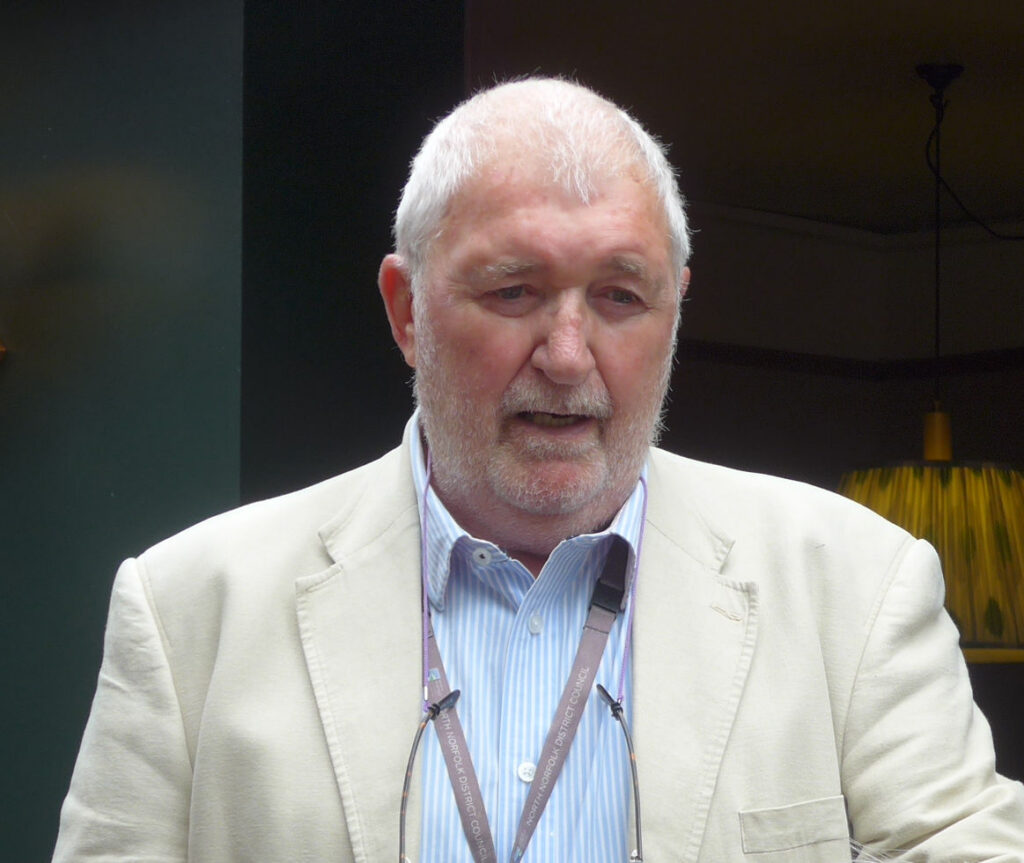
Holt and District Probus Club met at The Feathers in Holt on the 3rd June and after the usual excellent lunch were introduced to Brian Farrow.
Brian spoke about the Sheringham Lifeboat, though he has long been associated with the Sheringham Shantymen as well as the lifeboat.
It is a sad fact that at present there is no Sheringham lifeboat. Although it has a noble history, the cliff behind their lifeboat station has been deemed unsafe so the place has been locked up and it is likely to be some months before anything is done about this.
Meanwhile, the proud history of the station was still well worth recounting. The station was established in 1838 when a private lifeboat was provided by the Hon Mrs Upcher and named after her youngest daughter, Augusta. In 1894 this boat was replaced by another private lifeboat, the gift of the late Mrs H R Upcher in memory of her husband and named after him, Henry Ramey Upcher. This boat can still be seen in the shed near the old launch site.
The first Royal National Lifeboat Institution boat was sent in 1867; she was launched from a carriage that was housed at the east end of the town near the Crown Inn.
The present lifeboat house and slipway were constructed in 1936 at the western end of the Promenade at a cost of £7,616 for Sheringham’s first motor lifeboat.
The Sheringham lifeboat has effected several major rescues, including the rescue of 15 men from a Canadian steamer Eaglescliffe Hall on 30 October 1941, the rescue of 4 men from the ss Zor of Istanbul on 19 May 1955, the rescue of 18 men from the ss Wimbledon on 31 October 1956. and the rescue of 4 people from the converted ships lifeboat Lucy on 15 August 1961. And numerous small boats in difficulty in the North Sea.
Francis Farrow – October 2025

Holt Probus Club met in early October, and enjoyed a lunch of fish pie with carrots and peas followed by sticky toffee pudding with ice cream.
After the meal, the speaker was Mr. Francis Farrow, hon. warden at Beeston and Sheringham Commons who spoke about that very interesting site.
The main commons are Beeston and Sheringham, which jointly make up the SSSI/SAC areas and are located south of the A149. Smaller commons comprising Beeston Back Common and Beeston Common (north) are situated to the north of the AI49. Francis has been a warden there for – years!
An early Norfolk map by Faden (1797) shows Beeston and Sheringham Commons to be more extensive than their present size of about 60 acres. The designation as a Site of Special Scientific Interest (SSSI) is because the wildlife and geography of the commons are of considerable interest.
But it all needs continual attention. Francis explained how the main pond had been enlarged and a “scrape” had been created to improve things for wild birds and animals; the vegetation requires regular attention to retain the kind of habitat that is required.
In September 2025, for example, more than two dozen different species of birds, mammals, insects and reptiles were seen. A meticulous record is maintained of sightings – and these can be seen listed on the commons’ website. Over time, over 400 flowering plants have been recorded including no less than 14 British orchids, 26 species of butterflies, 19 species of dragonfly/damselfly, as well as adders, grass snakes, slow-worms and common lizards.
John Allan – August 2025

Holt Probus Club met on Wednesday 6th August at The Feathers in Holt for their monthly gathering, lunch and talk. The meal was haddock and chips, followed by eton mess, and then coffee and mints.
The speaker was Mr John Allan, who had been billed as talking about Bomber Command. It turned out to be much more specific – the talk was about 100 Group, a part of Bomber Command which was formed in November 1943 to specialise in the complex business of electronic warfare and countermeasures.
Although part of Bomber Command, interestingly the Group had few bombers, mostly using De Havilland Mosquito fighters – the famous wooden framed twin engine machines.
100 Group operated primarily from airfields in North Norfolk, including several such as Little Snoring – not far from Holt! Using the electronic devices installed in the Mosquitoes, the 100 Group detected enemy radar and radio emissions. They enabled the RAF fighters to disrupt and harass the Luftwaffe exercises to the extent that a high proportion of enemy aircraft and personnel were wasted.
The innovative tactics of 100 Group played a vital role in supporting the Allies’ bomber offensive during the war.
Clare Stevenson – July 2025

Holt Probus Club met on Wednesday 2nd July at The Feathers in Holt for their monthly gathering, lunch and talk. The meal was chicken supreme, followed by lemon posset and biscuit, and then coffee and mints.
The distinguished after-dinner speaker was Dr Clare Stevenson, from the John Innes Centre in Norwich. Clare works closely with the Director as the interface between the Director and many aspects of day-to-day functioning of the John Innes Centre by providing support, advice and the strategic context required for leadership.
As a structural biologist Clare has extensive expertise in solving the structure of proteins using crystallography and is proud to have had a technical career path that has led to senior management.
One aspect of the John Innes Centre’s future plans is with the so-called “hp3” plan – involving the Centre’s links with the Sainsbury Laboratory, developing new ways to harness the power of plant and microbial science to feed the world and safeguard the health of the planet.
Thanks were proposed by member Bob Ward and a generous round of applause from all present.